

Sustainable by Design
What if sustainability wasn't about how long you could keep going, but about whether the going was actually worth sustaining?
That is a different question than the one most business advice asks. Most of it is concerned with endurance. How do you keep up the pace? How do you maintain output? How do you scale without breaking? The assumption underneath all of it is that the direction is right and the only problem is the stamina.
But stamina in service of the wrong thing is not sustainability. It is just a slower kind of depletion.

Simple by Design
What if the most sophisticated thing you could do for your business was to make it simpler?
Not smaller. Not less capable. Not stripped of what makes it work. Just clearer. Easier to navigate for the person who has to run it every day. Built for the business you actually have, not the one you are dreaming or manifesting.
That is what simplicity means as a design principle. And it is harder to choose than it sounds, because we are surrounded by a completely different operating system.
The default assumption in most business advice is that more is better. More automation, more tools, more systems, more capacity. All built for growth. Complexity gets dressed up as sophistication. A sprawling tech stack becomes evidence of a serious business. The question is almost never: Does this actually make things clearer? It is almost always: how do we do more?

Intentional by Design
I have left more than one job because of a gap.
Not a gap in skills, or resources, or even vision. A gap between what an organization said it stood for and how it actually operated from the inside. The mission statement on the wall and how people were, or were not, supported. The values listed on the website and the expectations that greeted you on a Monday morning.
I raised it however I could. I tried to help close it. And when I hit enough resistance and started to feel the disconnect in my body, I eventually had to go.
What struck me each time was not exactly the hypocrisy. It was the unawareness. Most of these organizations genuinely believed they were living their values. The gap wasn't intentional. It was structural. Nobody had examined whether the systems underneath the values were actually built to carry them, not just for the clients or customers, but also for those inside delivering the service.
That is the work intentional design tries to do.
Before you add another tool, answer these three questions
There is a particular kind of afternoon I know well. The work is not moving. Something feels inefficient, broken, or just hard. And somewhere in the background, a small voice starts asking: maybe there is a tool for this.
Sometimes there is. Often, there isn’t, at least not one that actually makes sense. And the difference between those two situations is harder to see in the moment than it should be.
I have added tools I did not need. I have experimented with even more and been down many rabbit holes. I have built systems that became the work. I have spent a Saturday setting up something I stopped using by Wednesday, because I hated the interface. Anyone else?
What I have learned, slowly, is that the question is rarely which tool. It is almost always best to first ask if a tool is the right answer at all. And the only way to know that is to get specific about the problem first.

The tools I actually use
People ask me about tools a lot. What do I use for scheduling? What about invoicing? How do I manage my calendar without losing my mind?
For a long time, I answered these questions one conversation at a time. Then I realized I was having the same conversation over and over, which is usually a sign that something wants to be written down.
So I wrote it down.
My tools page is my honest answer to the question: What do you actually use? Not what I have tried or used in the past, not what I want to try, not what a client is using. But what is open on my screen on a regular Tuesday.
What My Mailbox Taught Me About Connection
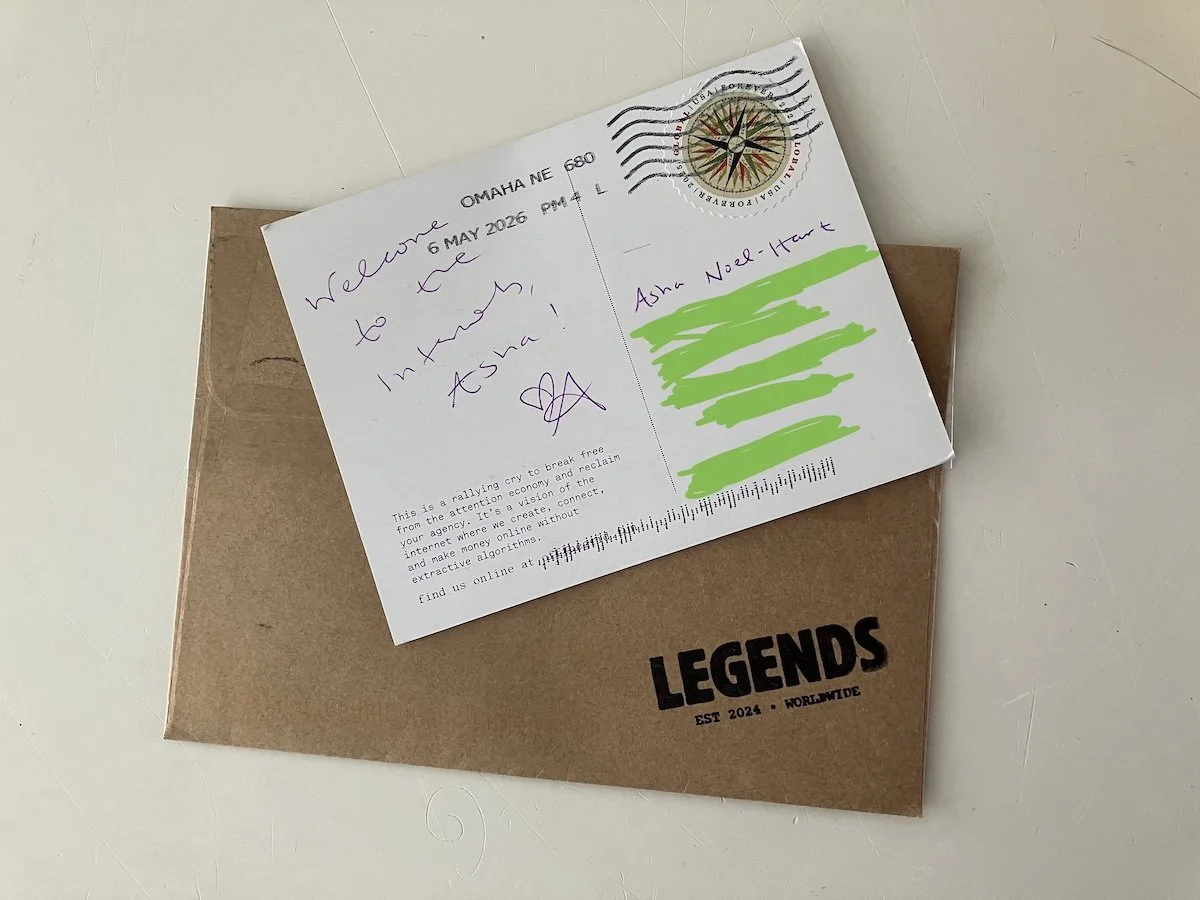
A sprinkle of joy and gratitude in that moment for these 2 pieces of paper in my hand. Something so simple. There was something about a handwritten note that bypasses all the noise. No algorithm decided I should see it. No one optimized the timing. Someone just sat down, picked up a pen, and thought of me. It brought back a kind of nostalgia I didn't know I was missing. Simpler, slower, more deliberate ways of reaching out. That costs a little time and intention.

Regenerative Possibilities…
There's a theme I've been sitting with. One I didn't rush into — I took my time to let it land. And what settled, quietly and with some insistence, is this:
Regenerative possibilities.
Not a strategy. Not a trend. A posture. A way of turning toward the world with open hands instead of clenched fists.

Why a regenerative perspective?
I didn't set out to build a regenerative business. I set out to survive.
The real problem isn’t business itself. It’s the capitalist operating system that defines how most businesses run. So how can I do business differently? How can I shift the narrative?
What can we do instead of accepting the system as-is and trying to do a little good around the edges? Regenerative thinking offers the possibility of creating something new and potentially shifting the system.